February 15, 2026
Glacier Dynamics and Hydrology in the St. Elias Mountains
Posted by Jaime Dubé
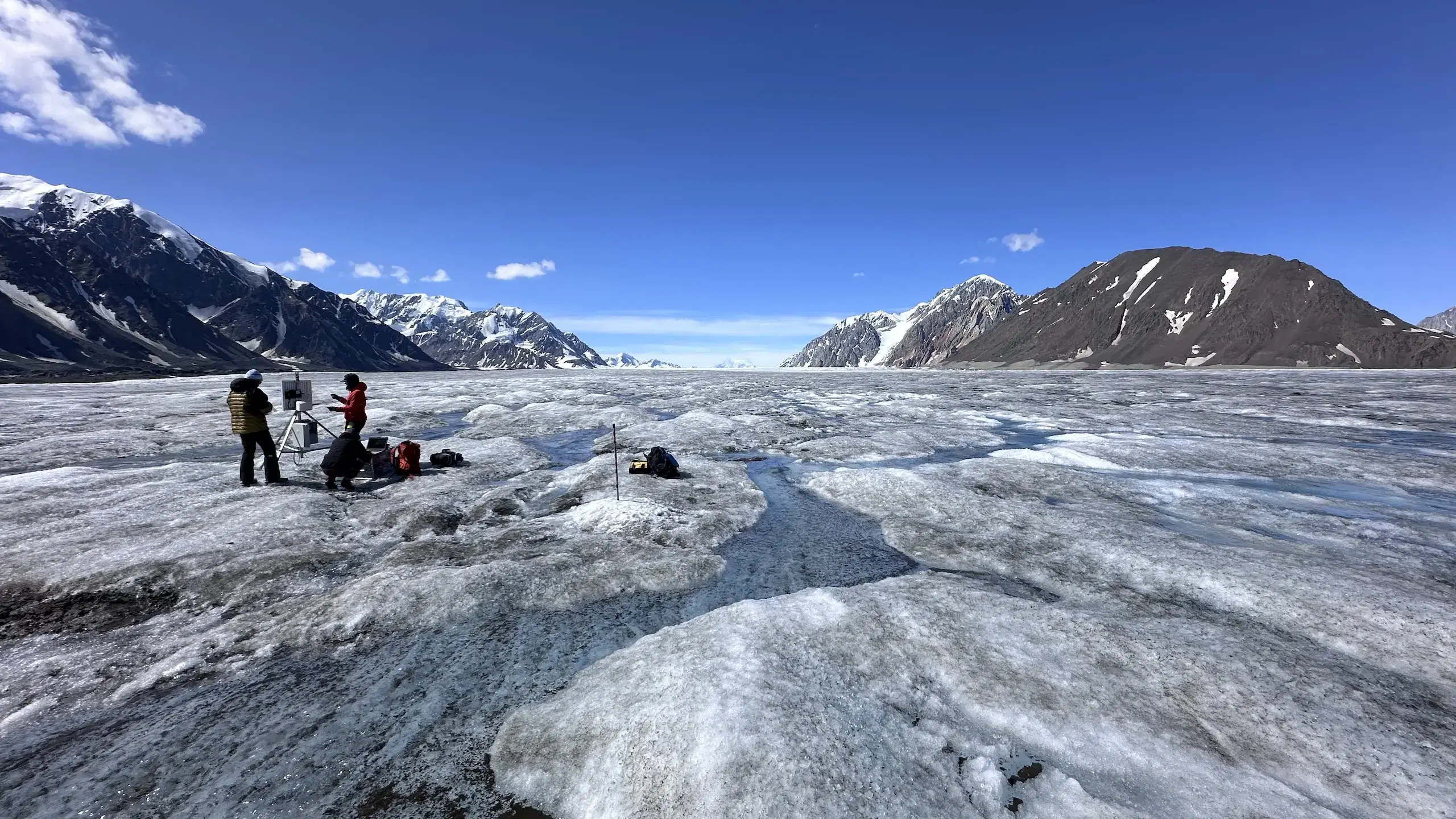
The team servicing a Cryologger GVT on Kaskawulsh Glacier, Yukon in summer 2025.
Introduction
Members of our research team have been working in the St. Elias Mountains since 2007, studying glacier dynamics and hydrology across the region. Beginning in 2021, we transitioned from commercial survey-grade glacier velocity stations to Cryologger Glacier Velocity Trackers (GVTs).
This shift allows for more energy-efficient instrumentation and more targeted monitoring of glacier motion in this remote and dynamic mountain environment. Today, Cryologgers form the foundation of a growing instrument network designed to better understand how glaciers in the St. Elias Mountains are changing and how those changes influence downstream systems.
🏔️ Why the St. Elias Mountains?
The St. Elias Mountains are located within the traditional territories of Champagne & Aishihik First Nations, Kluane First Nation, and White River First Nation, within Kluane National Park and Reserve.
Glaciers in this region strongly influence downstream hydrology that nearby communities rely upon. Changes in glacier mass balance and flow affect river discharge, sediment transport, and seasonal water availability.
From a glaciological perspective, the region is uniquely diverse. It contains a wide range of glacier dynamics, including a large cluster of surge-type glaciers. The combination of dynamic variability and proximity to communities makes understanding the mechanisms driving glacier change in this region particularly important.
📡 A Growing Instrument Network
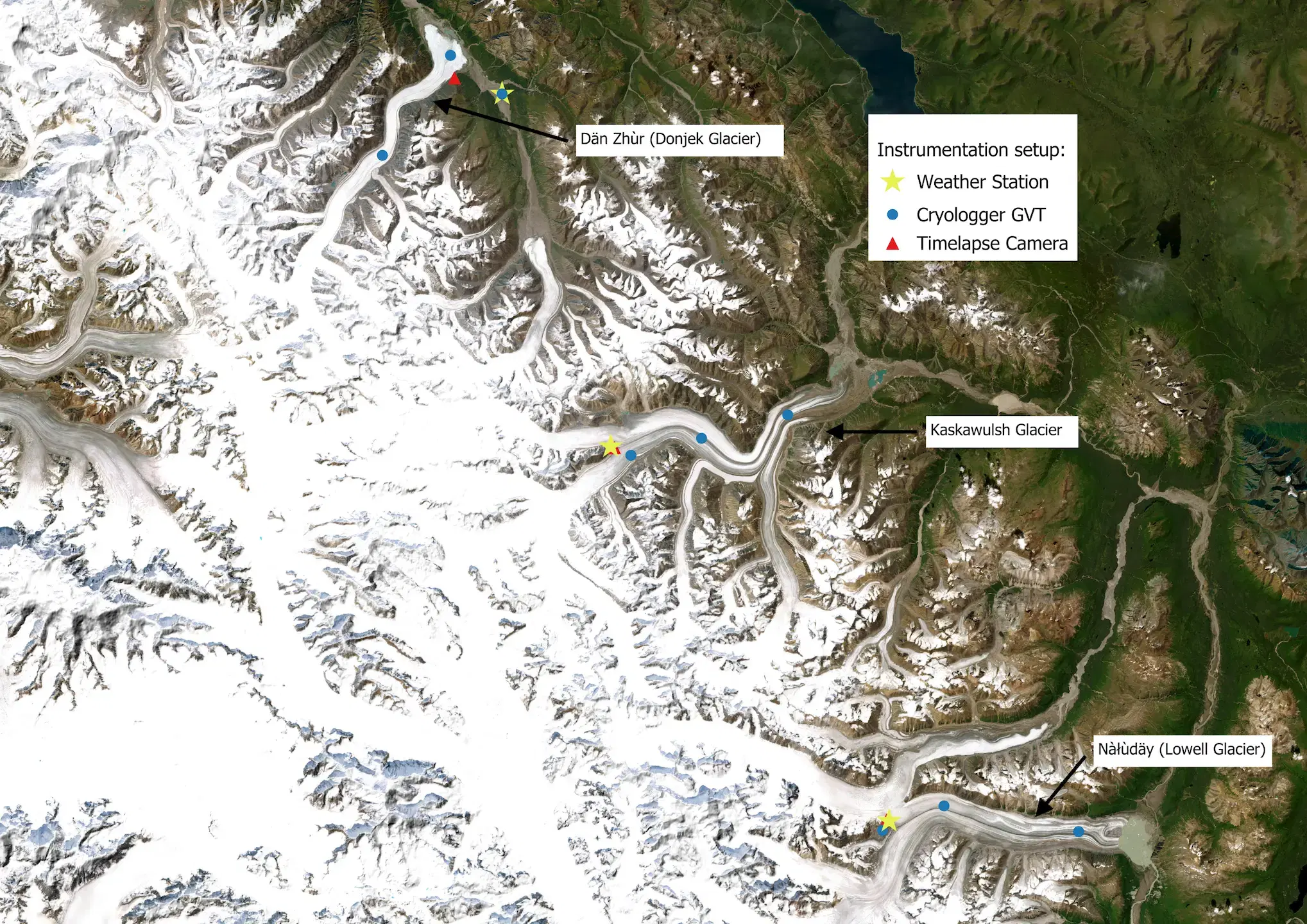
Map of research instruments in Kluane National Park and Reserve.
Our instrument network currently consists of:
- 10 Cryologger GVTs
- 3 all-weather stations
- Several time-lapse cameras
This work is a collaborative effort between the University of Ottawa and the University of Waterloo, led by Dr. Luke Copland and Dr. Christine Dow.
On three key glaciers in the region, two GVT systems are installed per glacier. Several stations are co-located with:
- A time-lapse camera
- An ablation stake recording melt rates hourly
- A HOBO sensor measuring hourly air temperature and relative humidity
Stations are configured to record GNSS data daily from 19:00 to 22:00 UTC (11:00 to 14:00 local time). Between April 15 and September 30, higher-frequency seasonal measurements are collected to capture peak melt and dynamic variability.
During the summer 2025 field season, two GVTs were relocated to bedrock near Nàłùdäy and Dän Zhùr to act as base stations for improved glacier velocity processing.
📍 Monitoring Three Distinct Glaciers
We use Cryologger GVTs to track glacier dynamics across three glaciers in the region:
- Nàłùdäy (Lowell Glacier)
- Kaskawulsh Glacier
- Dän Zhùr (Donjek Glacier)
Nàłùdäy and Dän Zhùr are surge-type glaciers. Their most recent surges occurred in 2021–2022 (Nàłùdäy) and 2012–2014 (Dän Zhùr). In contrast, Kaskawulsh Glacier does not surge and serves as a control site for analysing surge behaviour.
By operating identical instrumentation across these systems, we can directly compare:
- Surge versus non-surge dynamics
- Seasonal velocity patterns
- Links between meltwater input and short-term accelerations
This consistent network design allows for rigorous inter-glacier comparisons and improved understanding of glacier–hydrology coupling.
🔬 How We Use the Cryologgers
Cryologger GVTs are designed for long-term, autonomous glacier deployments. Their low power consumption and modular architecture make them well suited for multi-year operation in cold, remote environments.
In the St. Elias Mountains, they support research on:
- Seasonal and interannual velocity variability
- Surge onset and decay processes
- Melt-driven short-term accelerations
- Glacier contributions to regional hydrology
By combining GNSS velocity measurements with meteorological data, melt observations, and imagery, we can investigate not only how fast glaciers move, but why they move the way they do.
Want to Learn More?
Real-time weather station data from Kaskawulsh Glacier:
DataGarrison Satellite Weather Station – Kaskawulsh Glacier
Research webpage:
Laboratory for Cryospheric Research
Instagram:
@lcr_uottawa
For research inquiries:
jdube074@uottawa.ca