September 11, 2026
Petermann Ice Island Breaks Apart
Posted by Adam Garbo
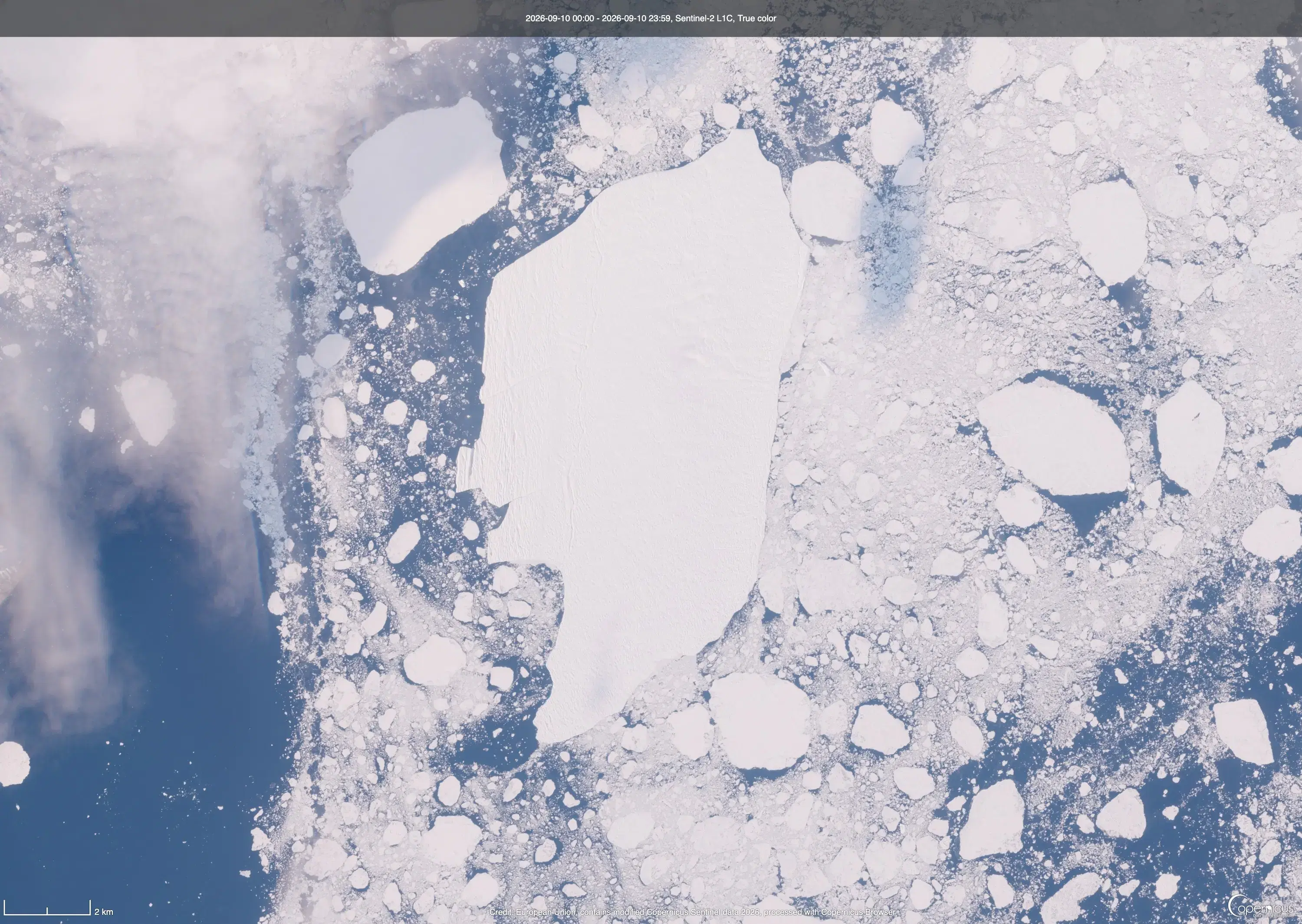
PII-2026 in Nares Strait on September 10, 2026, shortly before it broke apart. Copernicus Sentinel-2 imagery.
Introduction
Just over a month after calving from Petermann Glacier in northwest Greenland, the ice island that formed on August 4th, 2026 has broken apart.
The breakup was detected using two Cryologger Ice Tracking Beacons (ITBs) deployed on the ice island on August 30th, together with Copernicus Sentinel-1 satellite imagery. After initially drifting together, the trajectories of the two beacons began to diverge as the ice beneath them separated.
Sentinel-1 imagery from September 10th showed large fractures developing across the ice island. By September 11th, it had broken into multiple fragments, with the two Cryologger ITBs ending up on separate pieces.
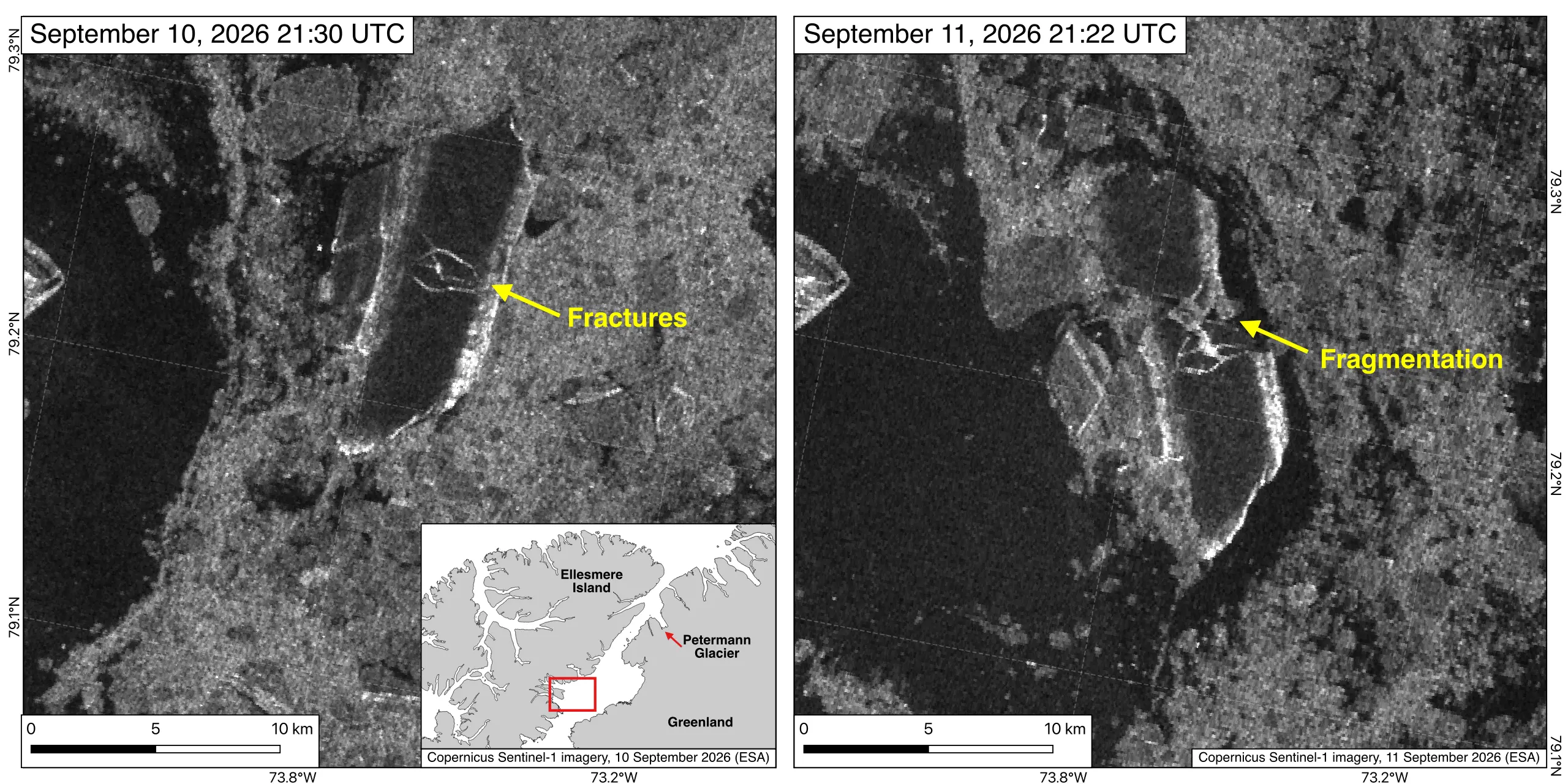
Copernicus Sentinel-1 radar imagery showing fractures across PII-2026 on September 10, 2026 (left) and fragmentation of the ice island by September 11, 2026 (right).
Detecting the Breakup
The two Cryologger ITBs were deployed on different parts of the ice island on August 30th. Their positions are transmitted by satellite, allowing us to follow the movement of the ice as it drifts away from Petermann Glacier.
For the first several days, the two beacons moved together. That changed on September 11th, when the distance between them began to increase. Both continued transmitting normally, indicating that the ice island itself had fractured.
The location of the breakup may also help explain what happened. Bathymetry shows that the water in this area is approximately 125 m deep, while preliminary radar measurements collected on August 30th suggest that parts of the ice island may be around 150 m thick. The ice island may therefore have run aground as it drifted through the area, contributing to the breakup.
Movement of two Cryologger ITBs deployed on the Petermann ice island on August 30, 2026. The beacons initially drift together before their trajectories separate during the breakup.
Mapping the Fragments
Cloud cover made it difficult to see the full extent of the breakup, but a clear Sentinel-2 image became available on September 13th.
This allowed me to map approximately 43 individual fragments, which together covered 73.06 km2. For comparison, PII-2026 covered 73.14 km2 before the breakup on September 10th. That leaves a difference of just 0.08 km2, which is likely within the uncertainty of manually delineating the ice boundaries.
The Sentinel-2 imagery also shows just how quickly the ice island broke apart, changing from a single large ice island to dozens of fragments in only a few days.
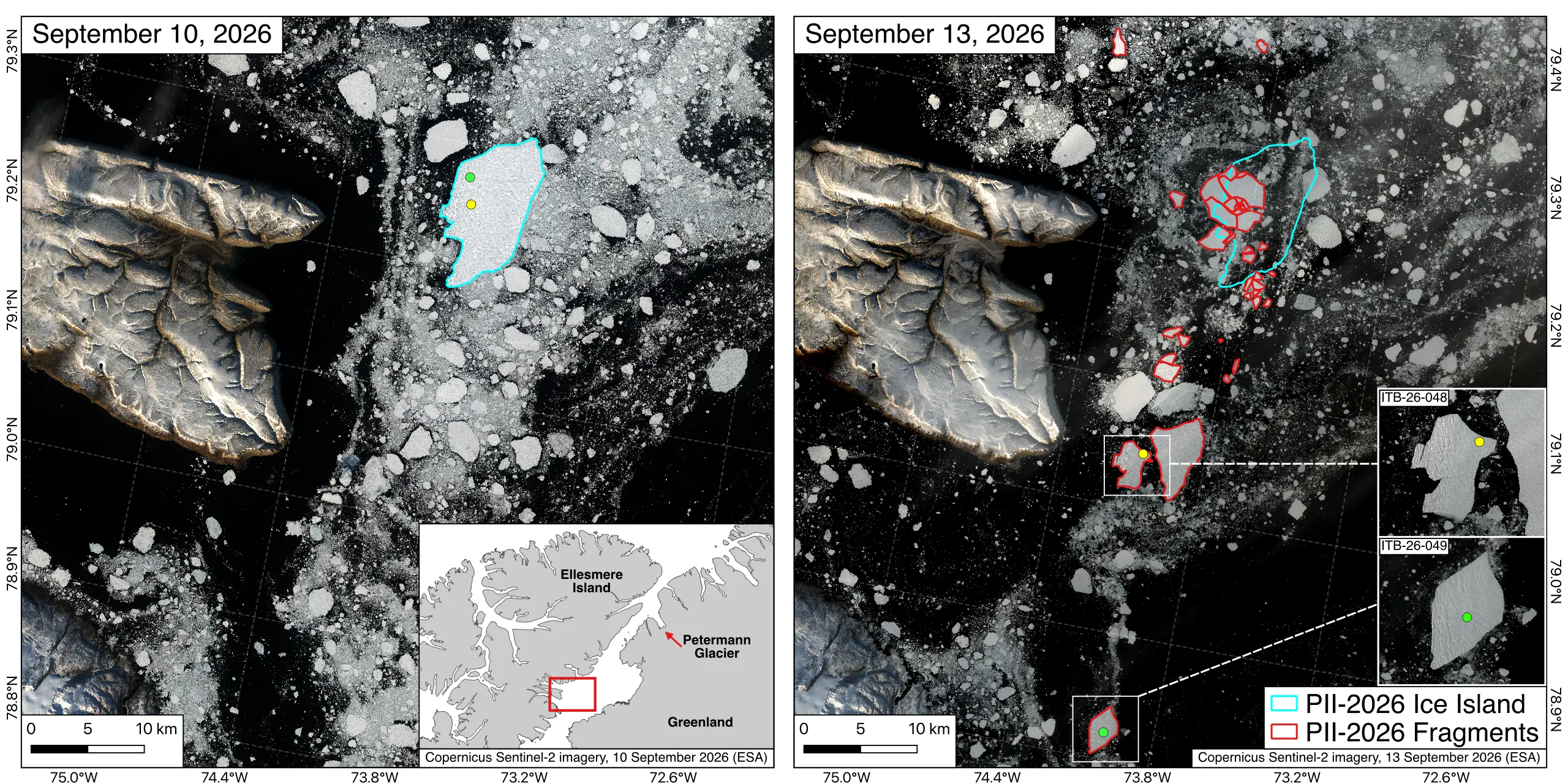
Copernicus Sentinel-2 imagery showing PII-2026 on September 10, 2026 (left) and September 13, 2026 (right). The cyan outline shows the extent of the intact ice island, while the red outlines show the approximately 43 fragments mapped after the breakup. The two Cryologger ITBs are shown on separate fragments in the September 13th image.
Still Tracking
Both Cryologger ITBs survived the breakup and continue to transmit from separate fragments. One fragment is moving quickly southwards, while the other has remained closer to the breakup area.
The breakup occurred only 37 days after PII-2026 calved from Petermann Glacier and 11 days after the Cryologgers were deployed. With both beacons still transmitting, we can continue following the two fragments as they drift through Nares Strait.
Follow the Petermann ice island fragments live on the Cryologger tracking map.
For more background on the August 4th calving event and the deployment of six Cryologger ITBs at Petermann Glacier, see Tracking the Breakup of Petermann Glacier.
Acknowledgements
The Cryologger ITBs were prepared for deployment at the Laboratory for Cryospheric Research at the University of Ottawa and deployed from the CCGS Amundsen by Daniel Farinotti and Raphael Moser of ETH Zurich, with helicopter support from pilot Sébastien Tremblay. I would also like to thank Ignatius Rigor and the International Arctic Buoy Programme (IABP), the captain and crew of the CCGS Amundsen, the Chief Scientists, and Amundsen Science for their support.